
Colin James Irving, violin, viola, and cello maker and restorer based near Bath, U.K., died on 23 March 2025 at the age of 80.
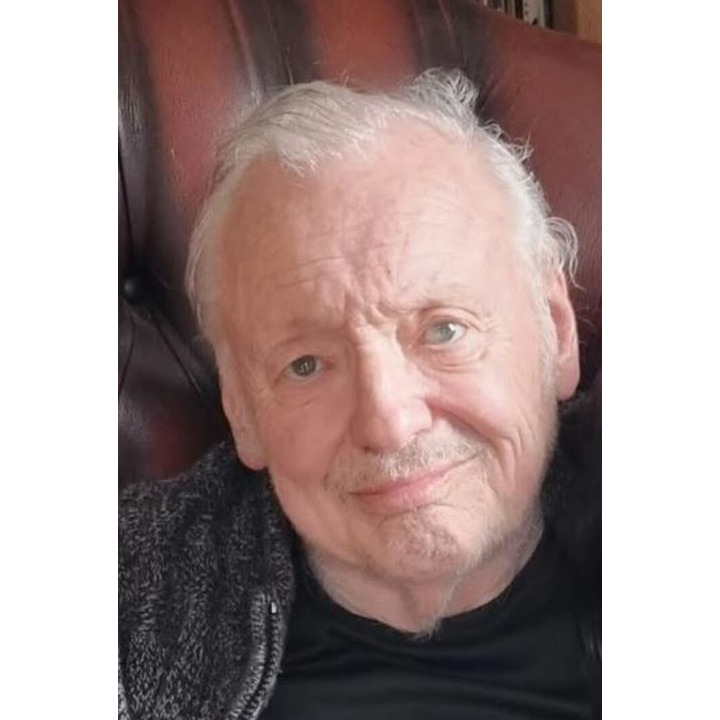
Colin James Irving (1945–2025): A Maker’s Maker. Photo: funeral-notices.co.uk.
Early Life and Engineering Foundations
Irving left school at 15 without formal qualifications and began work in the British Railways engine works at Eastleigh, near Southampton. There he developed a strong grounding in engineering — skills that would later inform the precision of his instrument making.
“Irving brought an engineer’s discipline to the art of instrument making.”
In the early 1960s he became involved at the design stage of large hovercraft, including the British Rail cross-Channel SRN4 and SRN6 series. Although engineering offered security, Irving’s interest in violins — he was himself a player — steadily deepened.
Recognising the declining prospects of the hovercraft industry and drawn increasingly to wood rather than metal, he wrote in 1966 to several musical instrument firms offering his services. The Dolmetsch workshop in Guildford replied positively.
Dolmetsch and the Early Music Revival
The Dolmetsch firm, central to the post-war early music revival in Britain, produced lutes, guitars, citterns, violins and other period instruments. Irving arrived with a violin he had made himself and secured a place in the workshop.

Arnold Dolmetsch and his family: c.1928 Back row: Leslie Ward (Cécile’s husband), Carl, Rudolph, Millicent Wheaton–Dolmetsch, George Carley. Front row: Mabel, Nathalie Dolmetsch–Carley, Arnold, Cécile Dolmetsch-Ward, Christopher Ward – Arnold and Mabel Dolmetsch’s family outside Jesses.
It proved formative. Arthur Bultitude, among others, was subcontracted to make bows, and foreign makers working on short contracts brought a range of techniques into the workshop. Immersed in this environment, Irving rapidly developed both his making and restoration skills.

Arthur Bultitude
He remained at Dolmetsch until 1970, leaving to work independently for London violin dealers. During this period he refined his restoration expertise, learning from the Cremona-trained restorer Gil Solomon, whose generosity he later acknowledged.
Establishing a Reputation
By the mid-1970s Irving had established himself as a full-time independent maker, sourcing his tonewood from Germany. A decisive moment came when he made a cello for the young Raphael Wallfisch. The instrument brought him immediate visibility among professional cellists, and commissions followed.
His work was featured in Mary Anne Alburger’s 1979 volume The Violin Makers, further consolidating his standing within the British making community. By the early 1980s he was married with two children and balancing professional success with family life.
Outside the workshop, Irving’s interests were pursued with characteristic thoroughness. A keen sailor, he obtained a Master Mariner’s certificate.
The Cellos
Over the following decades, Irving’s cellos formed an important part of his reputation. Players valued their structural clarity, projection, and tonal focus — qualities perhaps rooted in his engineering sensibility.

Cello by Colin Irving, Bath, 1988. Photo courtesy Aitchison & Mnatzaganian. Listen to the sound of the cello and learn more about it here.
His cellos were performed on by cellists including Raphael Wallfisch, Natalie Clein, Leonid Gorokhov, Matthew Barley, Stjepan Hauser, Ross Pople, Fiona Murphy, Catherine Black, Laura van der Heijden, and Kate Keats.
Several artists owned more than one of his instruments, reflecting their consistency and reliability in professional use.
Collapse and Renewal
In the 1990s, despite a full order book, Irving entered into partnership with a financial backer who subsequently disappeared after handling payments and deliveries. The resulting loss left Irving unable to meet his mortgage and forced him to relinquish his home.
He later spoke with gratitude of Hamilton Caswell, who offered him the opportunity to run Caswell’s string instrument workshop in Bristol. After several years rebuilding stability there, Irving re-established himself independently with a workshop near Bath.
An Unwritten Partnership in Rode
Around this time Andrew Hooker — formerly of Sotheby’s Musical Instrument Department — relocated to the Bath area to establish himself as a dealer. His premises, a deconsecrated church in Rode, stood close to Irving’s home. What Hooker later described as an “unwritten partnership” developed: Irving restored and prepared Hooker’s stock to exacting standards while continuing his own making.
Irving never ceased building new instruments during this period, while continuing his restoration work for Hooker’s stock. His reputation as a maker — particularly of cellos — steadily deepened, and his instruments remained in active professional use. Violist Christopher Wellington also played an Irving viola.
A Craftsman Beyond the Workshop
Irving’s mechanical aptitude never disappeared. He could undertake complex structural restorations with assurance, and his workshop housed equipment robust enough for metalwork as well as wood. He restored vintage cars, made historically informed body armour for the BBC, and even produced laminated longbows of yew and hickory after being told that such bows were no longer made. When demonstrated at a re-enactment event, the entire set sold immediately.
“He could move from metal lathe to maple plate without missing a beat.”
He was deeply knowledgeable about Wagner and the metaphysical poets, and took pleasure in discovering that his home lay near standing stones at Bathampton.
Legacy
Colin Irving belonged to a generation of British makers who moved fluidly between engineering precision and artisanal tradition. His instruments — particularly his cellos — continue to circulate among professional musicians, and his restorations quietly underpin many careers.
He is remembered not only for technical assurance and tonal discernment, but for resilience — rebuilding his life and workshop after profound loss.
His instruments will carry his name forward for decades to come.
Rest in peace.
This obituary draws on a piece by the late Andrew Hooker (d. January 2026), with contributions from Catherine Black and Andrew Bellis. We are grateful to all who assisted in preserving these recollections.


